Your Home & Solar A starter pack
Where do you fit?

Three Irish homes that made the switch

Three homeowners, three different reasons, and what changed for each of them.

An Irish home with solar panels on the roof in soft afternoon light
Before you read this

You filled in a form. That is a careful first step, and most people who do it have already spent a few weeks half deciding.

This is for the next part. Not "buy solar." Just: figure out where you sit.

Three houses follow. They are real homeowners, sized up against the patterns we see most often in Ireland in 2026. The names are changed. The systems, savings and payback figures are anchored to actual installs.

Read whichever case looks closest to your house. By the end you should have a rough sense of the system size that would suit you, whether a battery makes sense, and what to expect from the savings. When your installer comes out to survey the roof, you will already be speaking the same language.

If anything here raises a question, jot it down. The most useful site surveys are the ones where the homeowner arrives with the awkward question already written.

The basics

How it works, briefly

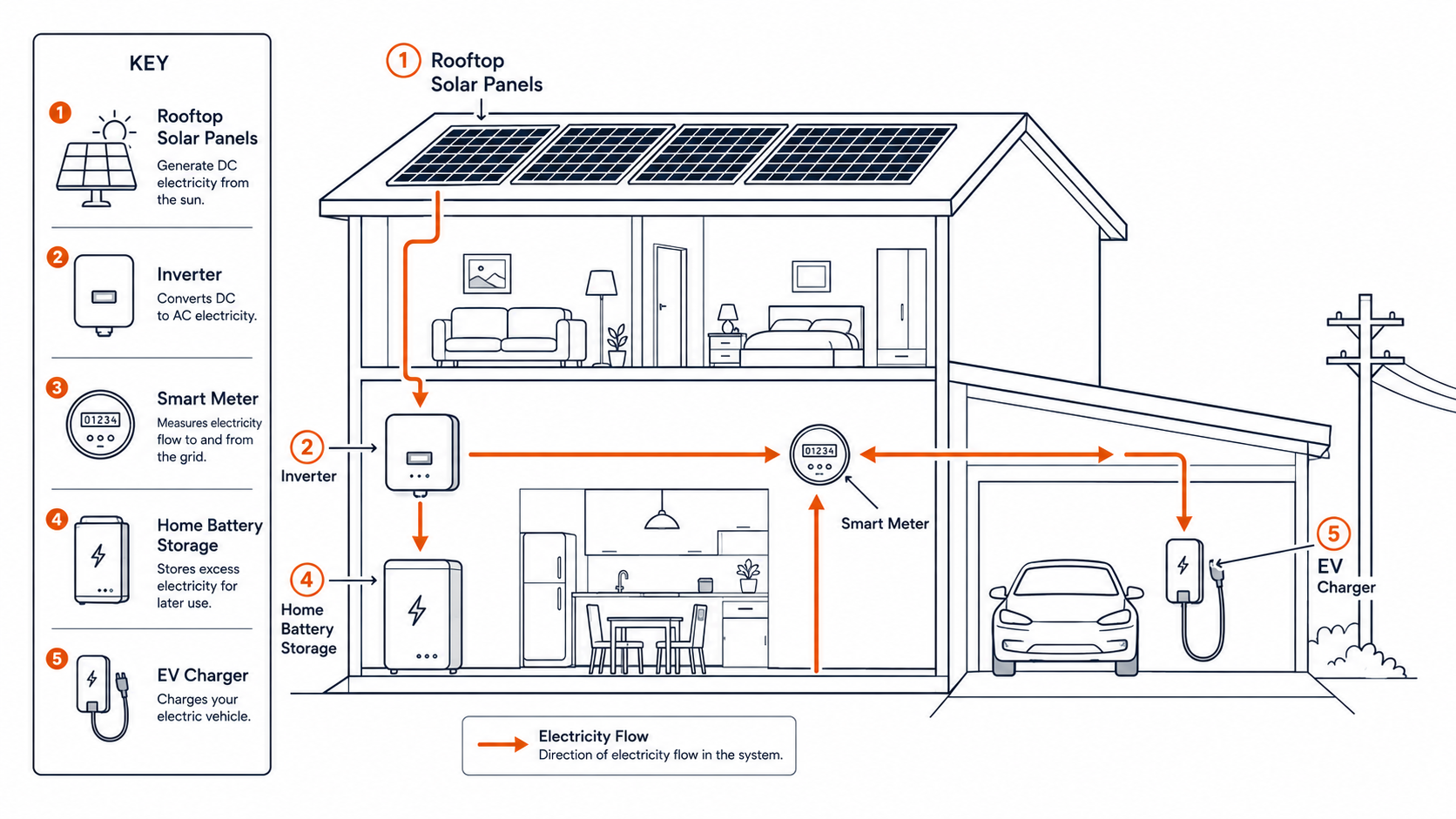
A solar PV system has three parts and one optional one.

Panels

They sit on the roof and turn daylight into electricity. They work on daylight, not heat, which is why they do fine in Ireland. South facing is best. East and west are about 85% as good. North facing is not worth it.

Inverter

Usually in the utility room or attic. It converts what the panels make into the kind of electricity your house runs on. Modern ones are called hybrid inverters because they can also manage a battery.

Smart meter

Most Irish homes now have one. It records the electricity you send back to the grid so your supplier can pay you for it.

Battery Optional

It stores what the panels make during the day so you can use it in the evening. Whether you need one comes down to a single question: are you home when the sun is up, or out?

That is the system. The rest is wiring, brackets, an isolator switch beside the fuse board, and the paperwork to register the connection with ESB Networks.

Why bother

What you actually get from it

Four real benefits, in order of how much they matter to most households.

Your bill drops, a lot

A properly sized system covers roughly half to two thirds of an Irish household's electricity over a full year. You will be close to self sufficient from April through September, and still drawing from the grid in December. For most installs the annual bill reduction sits in the €800 to €1,500 range.

You get paid for the rest

The Clean Export Guarantee means your supplier pays you for surplus electricity you send back to the grid. Suppliers compete on the rate, so it is worth comparing when you renew. The first €400 a year is tax free, an exemption that runs to the end of 2028.

The state pays a chunk

The SEAI grant is €700 per kWp for the first 2 kWp and €200 per kWp for the next 2, capped at €1,800. On top of that, residential solar is 0% VAT in Ireland, worth roughly another €1,000. Public funding can come to around €2,800 on a typical install.

It pays for itself

Residential systems in Ireland are paying back in roughly 4 to 7 years right now, depending on how the house uses electricity. Panels are warrantied for 25 to 30 years. Everything from year eight onwards is essentially free electricity.

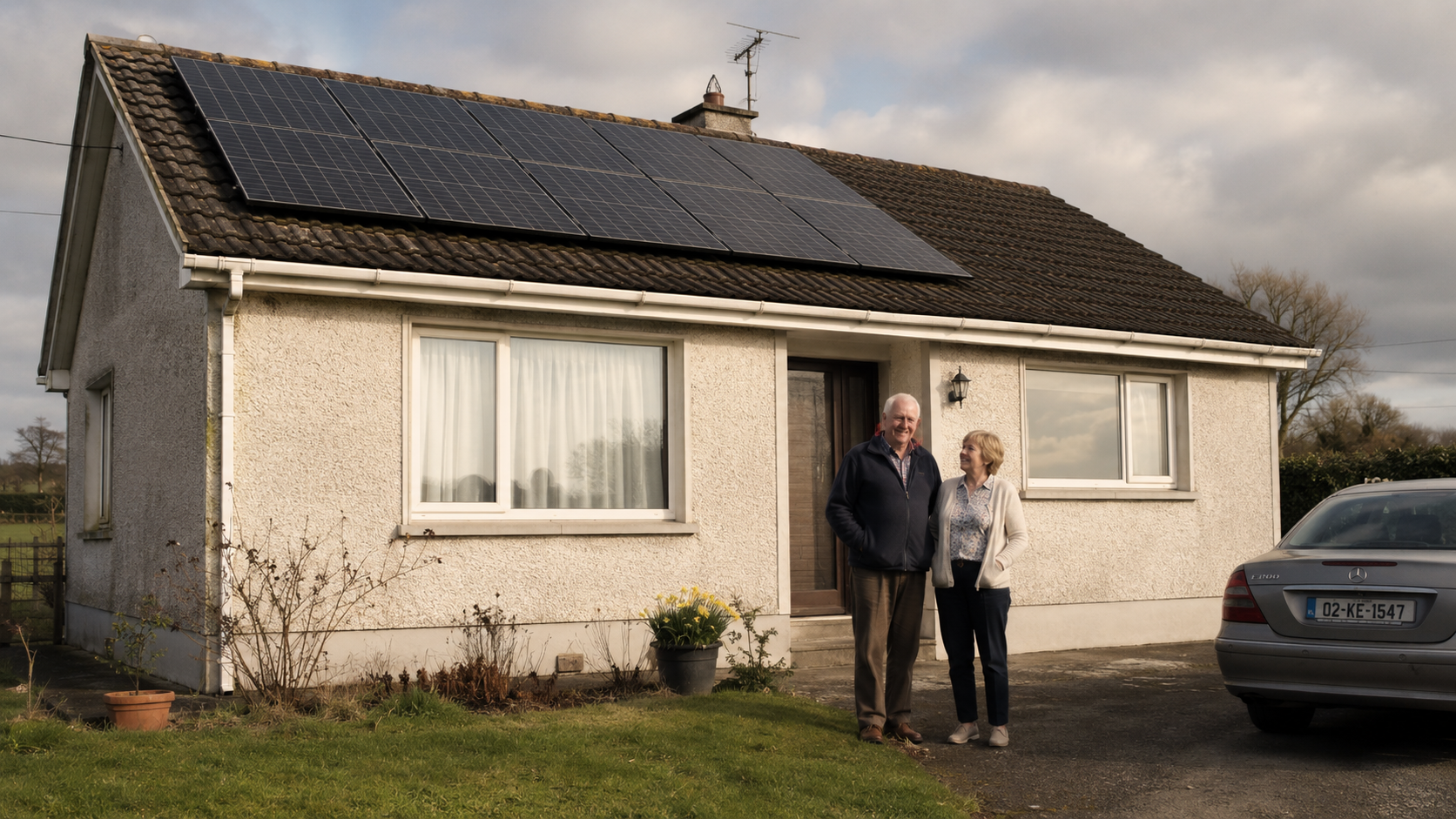
A 1980s Irish bungalow with solar panels on a slate roof Bungalow · retired couple
Case one

Pat and Eileen

Bungalow, mid sixties

Pat and Eileen were sure they were the wrong sort of customer.

They had read that solar only really pays off with an electric car, and they do not have one. Pat's car is twelve years old and he would rather drive it into the ground than replace it. Their daughter has an EV but she lives in Dublin and visits once a fortnight.

This comes up a lot. The EV is the most common reason people think solar is not for them. It is also one of the least relevant, depending on how the rest of the house runs.

The actual question is simpler. When the sun is producing electricity, is anyone home to use it?

For Pat and Eileen, yes. Both retired, mostly home during the day. The dishwasher runs at lunch, the washing in the morning, the immersion in the afternoon. That pattern lines up with peak generation almost exactly, which means most of what the panels make gets used straight away.

That changes the system design. They do not need a battery. A battery's job is to hold daytime electricity until you come home at six. If you are home at noon, you have already used it.

So the system was 3 kWp, six panels on the south pitch, no battery, a single hybrid inverter in the utility room. Two days on site.

The annual generation is around 2,400 kWh, with a self consumption rate close to 75%. The rest goes to the grid and shows up as a payment from the supplier every couple of months. Total saving for the year, bill reduction and export income together, comes to roughly €800.

Eileen mentioned that the July bill was the lowest she had ever paid. That was the moment, she said, that she stopped second guessing it.

"We assumed we were too old for this. The installer said we were exactly the right house for it. It made more sense once he explained it." Pat
System size
3 kWp
Battery
None
Annual generation
~2,400 kWh
Annual saving
~€800
Payback
~6 yrs
SEAI grant
€1,600

Why no battery?

When the household is home during the day, the panels feed the house directly. A battery would add cost without adding much saving for that pattern. Around half the retired or work from home households we assess go this route.

Higher use version

Add a heat pump or daytime EV charging and the system grows to 4 kWp with a 5 kWh battery. The saving moves into the €1,000 to €1,200 range.

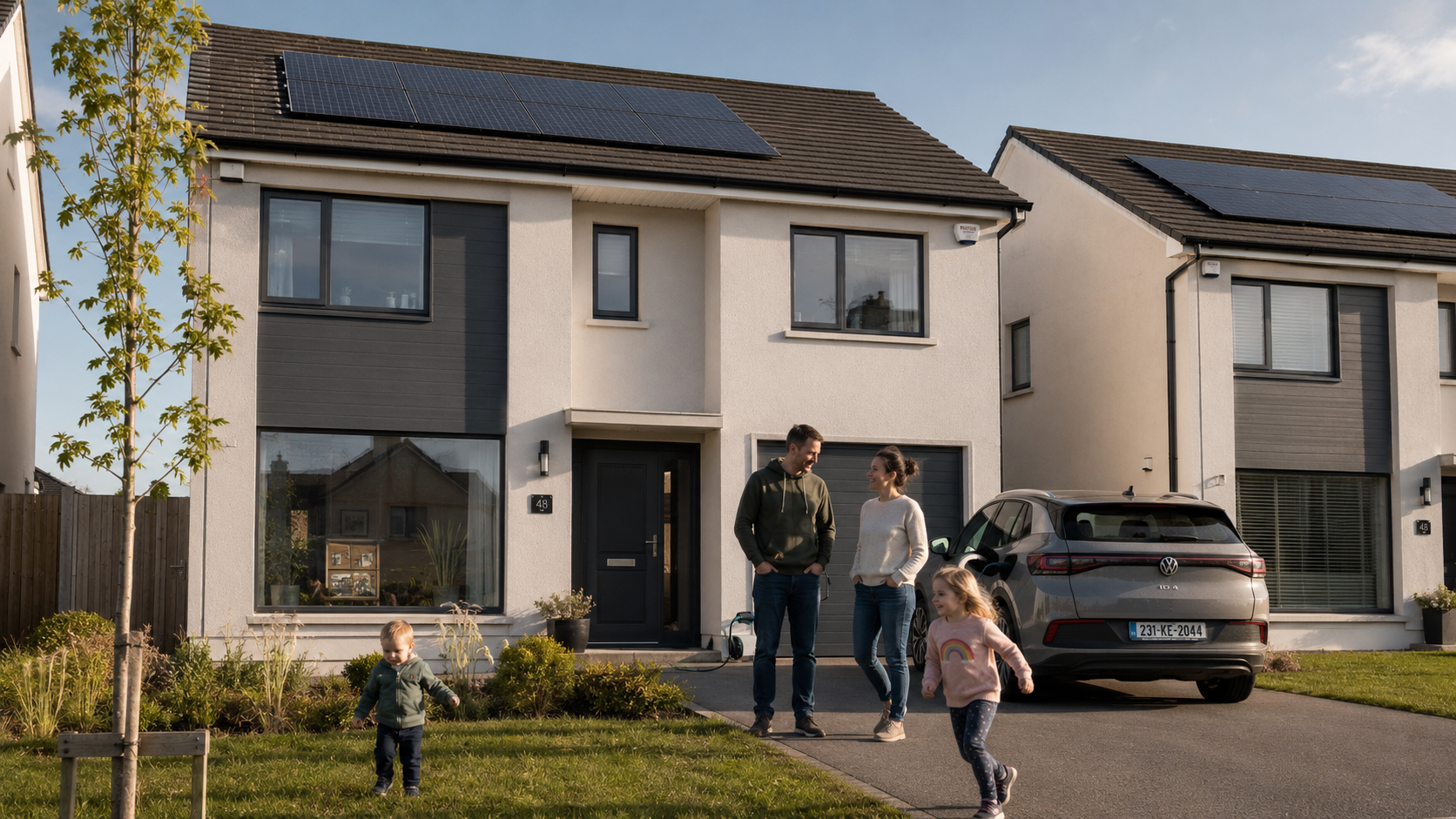
A modern Irish three bed semi detached house with solar panels Semi-detached · young couple
Case two

Aoife and Conor

Three bed semi-d, commuter belt

Aoife and Conor are out of the house from quarter past seven in the morning to six in the evening.

This is the most common shape of household we install for. Both working full time, no kids yet, first house. They bought just before rates climbed and the energy bills landed on top of that. The enquiry came in after a winter bill that surprised them.

The diagnosis is the opposite of Pat and Eileen's. The sun is making electricity all day. The house is empty all day. Without a battery, almost everything the panels generate goes straight to the grid at whatever export rate the supplier pays. That rate is fine, but self consumption pays back better.

A battery shifts the maths. The panels charge it during the day, and the household pulls from it in the evening when everything happens: cooking, showers, the dryer, the telly. Self consumption goes from around 30% to 70%, and the saving compounds over the year.

So the system was 3.7 kWp with a 10 kWh battery. Nine panels on a south east pitch. It is not large because it does not need to be. A bigger system would generate more, but most of the extra would just get exported, which does not pay back as well as self consumption does.

The annual saving works out around €850. The first quarterly bill after switch on came in at €74, against €312 the same time the previous year. Some of that is the season. Most of it is the panels.

Aoife said the bit that surprised her was how unobtrusive it is. The panels are on the roof, the inverter is in the utility room, and apart from the app there is no day to day fuss. It runs itself.

"The grant was what made us do it now rather than in two years. We would have kept putting it off otherwise." Aoife
System size
3.7 kWp
Battery
10 kWh
Annual generation
~2,700 kWh
Annual saving
~€850
Payback
~7 yrs
SEAI grant
€1,740

Why a battery for them?

With both of them out of the house during peak generation, a battery captures daytime production for evening use. Self consumption rises from around 30% to 70%.

Higher use version

Add an EV and the maths shifts again. Typically 4 to 5 kWp with a 10 to 12 kWh battery and a smart charger that prioritises solar. The saving moves into the €1,200 to €1,400 range.

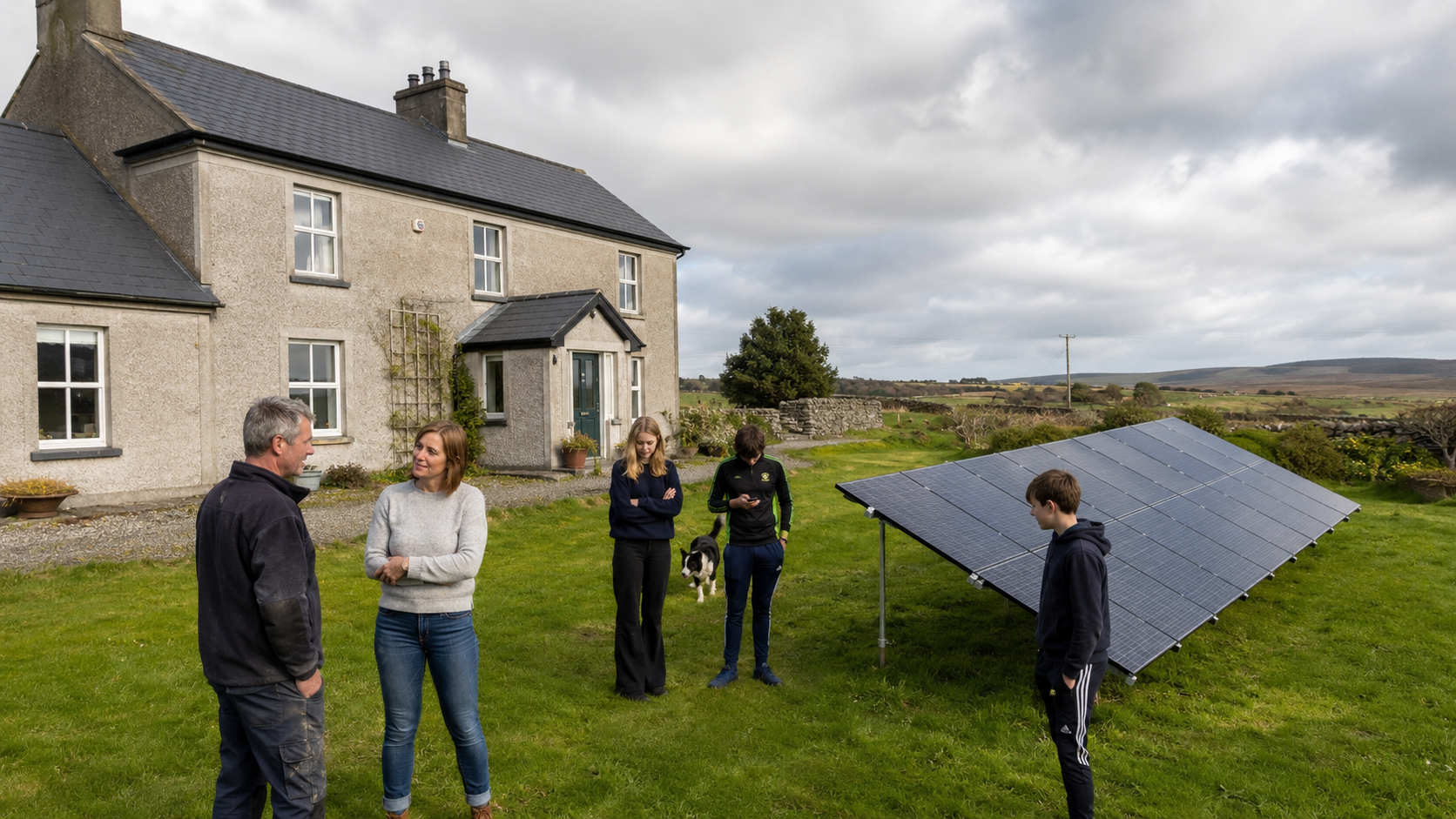
A detached Irish family home with solar panels and an electric car in the driveway Detached · family of four
Case three

Mark and Niamh

Detached, family of four, EV in the driveway

Mark and Niamh had been told twice that solar would not cover their usage.

Two earlier installers had quoted systems sized to match their consumption. The bill was just over €3,800 for the previous year, and on those numbers no roof in the country is going to fully replace grid electricity. The conclusion both reached was that solar did not really stack up for a household their size.

That is the wrong frame, and it is worth slowing down on, because it catches a lot of larger households.

Solar is not trying to cover an Irish household's full annual consumption. The sun is not out enough in December and January for that to be physically possible. What solar does well is flatten the daytime peaks and shift usage onto self generated electricity. The goal is not "replace the bill." It is "shrink it, and shift behaviour to take advantage of free midday electricity."

When we ran the assessment for Mark and Niamh, we modelled three changes alongside the install. The EV charging shifts from the night rate plan to a charge when the sun is out schedule on weekends and on Mark's three work from home days. The immersion gets a diverter, which sends surplus solar to the hot water tank instead of exporting it. The gas boiler stays for now, with a heat pump on the horizon for a later phase.

The system itself is 6.2 kWp with a 10 kWh battery. Sixteen panels, twelve on the south pitch and four on the east. The split is deliberate. Most installers put everything on the best pitch, but for a household with morning hot water demand and weekend EV charging, the east panels widen the generation window in a useful way.

The annual saving lands around €1,400. Against a €3,800 bill that sounds modest at first glance. The bill itself drops toward roughly €2,000. The €1,400 is what stays in the household account year on year, on top of that.

The hot water diverter is the part Niamh brings up first. She said running a bath at three in the afternoon in July, knowing it cost nothing, still feels strange.

"The first two installers gave us a flat no, it will not work for you. The right question was not whether it covers everything. It was what changes if we do it properly." Mark
System size
6.2 kWp
Battery
10 kWh
Annual generation
~4,200 kWh
Annual saving
~€1,400
Payback
~6 yrs
SEAI grant
€1,800
Notable
Hot water diverter · split south/east pitch

Why split pitch?

East panels widen the daily generation window. For a household with morning hot water demand and daytime EV charging, that matters more than maximising peak noon output.

Higher use version

Family with a heat pump plus EV plus immersion: typically 7 to 8 kWp with a 15 kWh battery and possibly a second EV charger. The saving moves into the €1,800 to €2,200 range.

Closest to you

Which house sounds most like yours?

There is no wrong answer. It just helps you frame the conversation when your installer comes out.

What happens next

No hard sell. Read this first.

Most brochures end with a "book your call today" panel. We would rather you understood the process.

1

The site survey

Takes 30 to 40 minutes. Someone checks the roof and pitch, opens the consumer unit to look at the fuse board, and asks how the household uses electricity. You do not need to prepare. They will get what they need by asking.

2

A written quote

Within a few working days. Not a "starting from" price. An actual sized system, with the panels, inverter, battery if relevant, the grant amount, the 0% VAT price, and the modelled annual saving for your specific house. The working, not just the conclusion.

3

No deposit until you sign

And no pressure to sign on the day. Nobody decides on a four figure purchase on a Tuesday afternoon. Take a week. Talk to your partner. Talk to the neighbour who already has it.

4

Then the install

Most homes are done in one to two days. The grant paperwork and the grid connection are handled for you. You will be generating before you have fully got your head around it.

Three things to think about before they come out

  • What is the daily rhythm of the house? Someone home during the day, or empty until evening?
  • An EV in the next three years? It does not matter if you do not have one yet. Planning matters more than the timing.
  • Roughly what is the monthly bill? An approximate figure is plenty. Nobody needs the exact number.

That is all. No spreadsheets, no homework.

And finally

Expect a call from your installer this week.

You have already done the hard part by enquiring. They will take it from here.